July 26, 2026
Choosing a Lightweight Vacuum for Seniors or Limited Mobility
Written by Mohamed
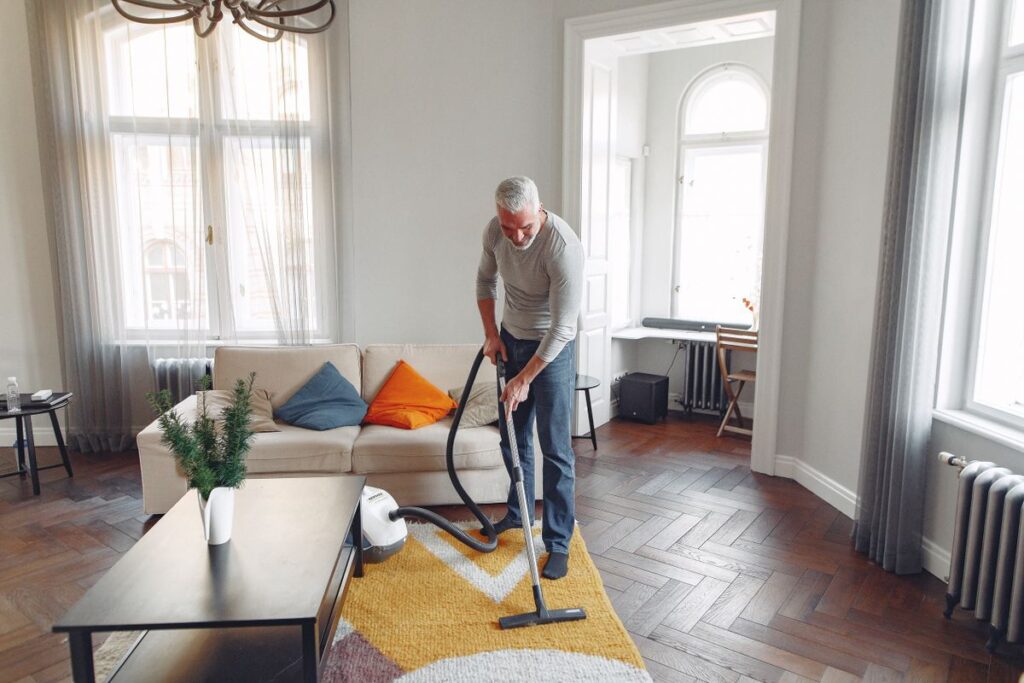
I carry a vacuum up and down stairs, in and out of vans, and through flats with no lift most days of the week. Weight isn’t an abstract spec to me, it’s something my shoulder has an opinion about by the end of a job. So when people ask what actually makes a vacuum manageable for someone with arthritis, reduced grip strength, or just less patience for wrestling with awkward equipment, I don’t start with the spec sheet. I start with how the thing behaves in your hand.
Total weight matters less than where that weight sits
A vacuum’s listed weight tells you almost nothing about how heavy it feels to use. What matters is balance: where the weight sits relative to where you’re gripping it. A cordless stick vacuum with the battery and motor packed into the handle end can feel noticeably harder to control than a slightly heavier machine with its weight sitting lower, closer to the floor.
This is why two vacuums that are within a few hundred grams of each other on paper can feel completely different in a five-minute test. If you can, hold the machine at the angle you’d actually use it, arm extended, for a full minute before buying. Anything that starts to feel like a genuine effort in that first minute will feel far worse on the tenth pass across a room.
Free checklist
Get Kiran's Free Fine Dust & Allergen Vacuum Checklist
Built after my son's asthma diagnosis, this is the exact five minute process I use before recommending any vacuum.
- HEPA seal red flags
- My five minute home test
- Proper bin emptying technique
- Questions to ask before buying
What “lightweight” actually looks like on the market right now
To be useful rather than vague, here’s what “lightweight” translates to in real, currently available machines, not as recommendations from us since we haven’t tested every model on this list, but as an honest picture of what’s realistic to expect at different weights and prices:
- Around 2kg: the Bissell Featherweight (2024E) is a corded, bagless 2-in-1 that converts to a handheld, sitting around this weight, typically priced somewhere in the £170–£250 range depending on retailer and offers.
- Around 2.2kg: Shark’s cordless stick range (the IZ201UK, for example) sits close to this weight in normal use, with a battery pack built into the handle.
- Around 3.1kg: Vax’s ONEPWR Blade 4 Pet is a heavier cordless option, closer to £260 at RRP, that trades some weight for a larger dustbin and longer runtime.
- Bagged cylinder alternative: if stick vacuums generally feel unstable in your hands, a small bagged cylinder like Hoover’s H-ENERGY 300 keeps the motor on wheels rather than in your grip entirely, which changes the whole ergonomics question — you’re guiding it, not holding its full weight.
Prices and exact specs shift regularly, so treat these as a starting point for what to search rather than a fixed shopping list.
The button matters as much as the weight
This gets overlooked constantly. Some vacuums need the power trigger held down the entire time you’re cleaning, which sounds minor until you’re five minutes into vacuuming a hallway and your hand is cramping from a sustained grip. A simple press-once-to-start, press-again-to-stop button removes that entirely. If grip strength or joint pain is a factor, this single design choice can matter more than the weight difference between two machines.
Cordless isn’t automatically the easier option
Cordless vacuums get marketed as the obvious choice for anyone who struggles with mobility, since there’s no cord to trip over or drag behind you. That’s a real advantage. But the trade-off is that the battery has to live somewhere on the machine, and it’s almost always in the handle, which is exactly where you don’t want extra weight if grip and wrist strength are the concern.
A corded vacuum is heavier to move around a room in one sense — you’re managing the cord as well as the machine — but the unit itself in your hand can genuinely be lighter, since it isn’t hauling its own power source. Neither format is a universal answer. It depends on whether cord management or hand-held weight is the bigger obstacle for the specific person using it.
A five-minute test worth doing before you buy
- Hold it at full extension for a minute, the same angle you’d use cleaning a floor. Note when, if at all, it starts to feel effortful.
- Check whether the power button is a hold or a toggle. A toggle switch removes sustained grip strain entirely.
- Empty the bin once, on the spot, before you’ve even used it. If the release catch itself needs strong fingers or a firm push, that’s a daily friction point you’ll hit long after the vacuum itself feels fine to carry.
None of this shows up on a spec sheet, which is exactly why it’s worth doing in person, or at minimum reading reviews that describe handling rather than just listing numbers.
Don’t rule out an upright
Stick vacuums get most of the attention in “lightweight” searches, but an upright with a stable base can actually be easier for some people, not despite being bulkier, but because of it. You’re pushing it along the floor rather than holding its full weight in the air the entire time you clean, and a lot of the balance concerns that make a light stick vacuum feel awkward simply don’t apply. If someone finds handheld and stick vacuums consistently tiring regardless of the model, it’s worth trying an upright before assuming the whole category is off the table.
One more thing worth checking
If allergies or fine dust are also a factor in your household, weight isn’t the only thing worth getting right. Our guide on what makes a vacuum’s filtration actually work covers the other half of the equation — a light vacuum that leaks dust back into the room isn’t doing the job either.